
Lecture 5
Mechanical Properties
1
Introduction
During the application/ service, many materials are subjected to forces or loads
Thus understanding of the relationship between microstructure of the materials
(internal structure) & their mechanical properties are very important
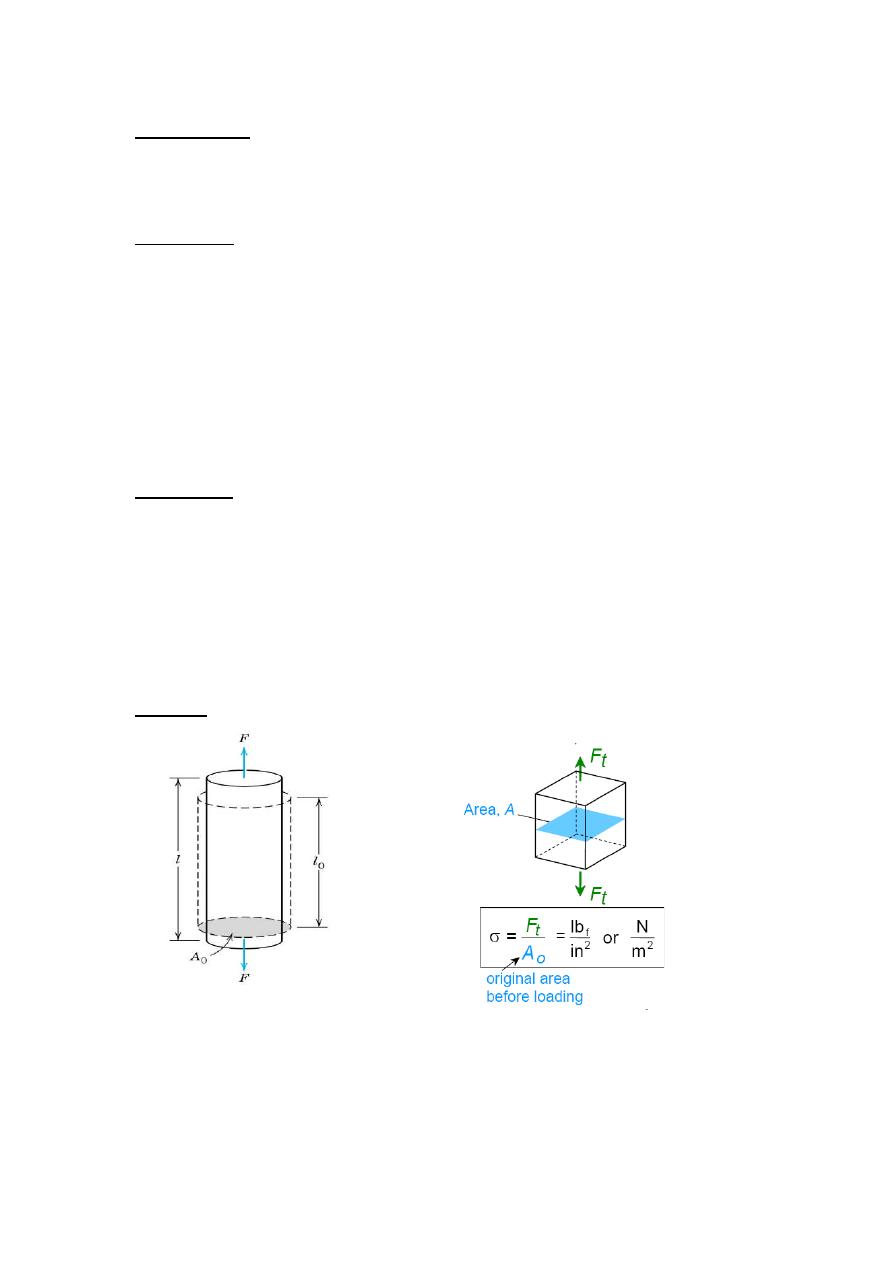
STRESS (σ):
Internal reaction of a structure to externally applied load; external load and
internal stress are equal in magnitude and opposite in direction.
σ = force / area
Units: MN/m
2
= MPa (M = 10
6
)
Types:
-Tension
- Compression
- Shear
-Torsion
STRAIN (ε):
Change in length per unite initial length;
ε
=L – Lo / Lo= ∆L / Lo
Units: dimensionless
Types:
- Elastic strain.
- Plastic strain.
Tension
Tensile stress, σ:
Lecture 5
Mechanical Properties
2
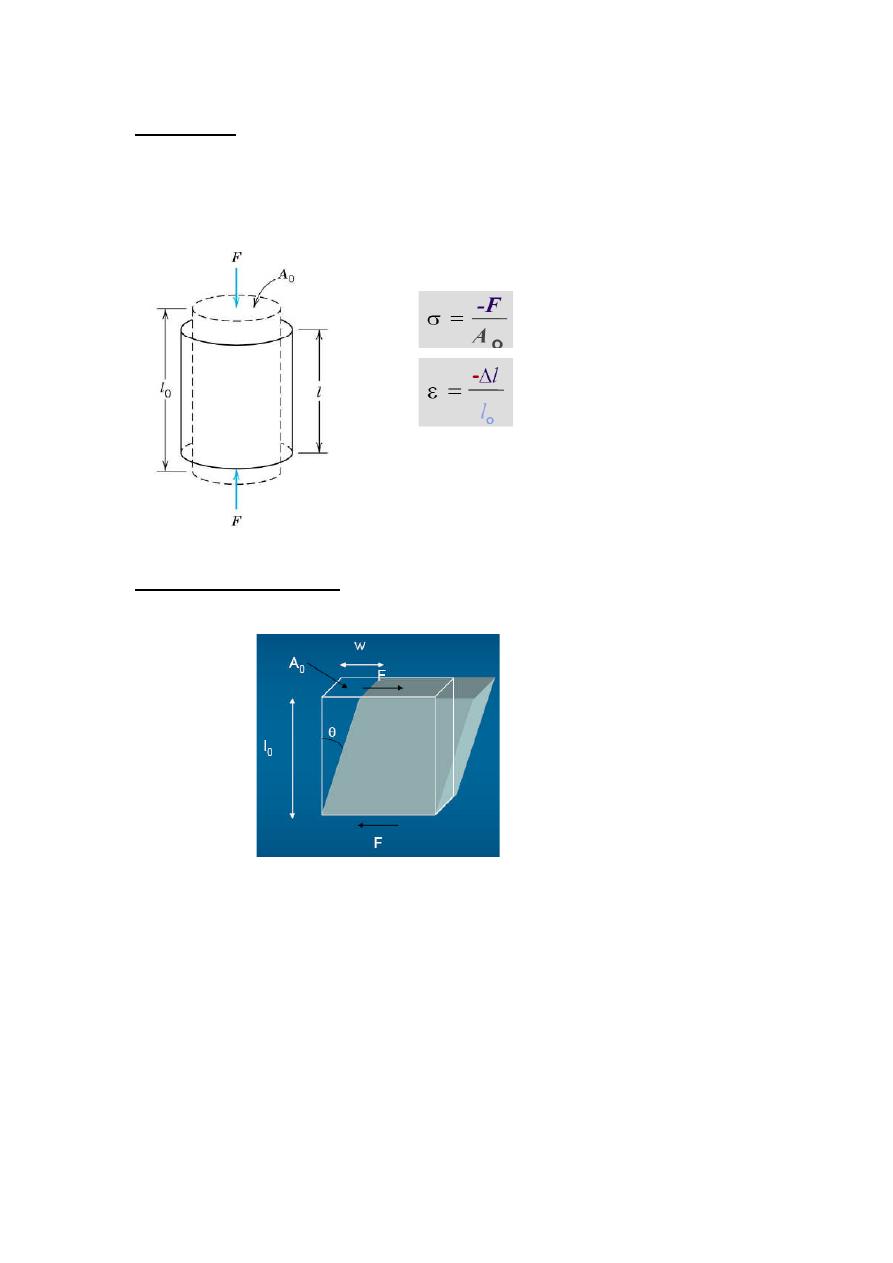
Compression
-The force is in compressive form
-The specimen contracts along the direction of the stress
-Compressive force is taken to be –ve, thus yields –ve stress
-Since Lo is greater than L, the compressive strains are also -ve
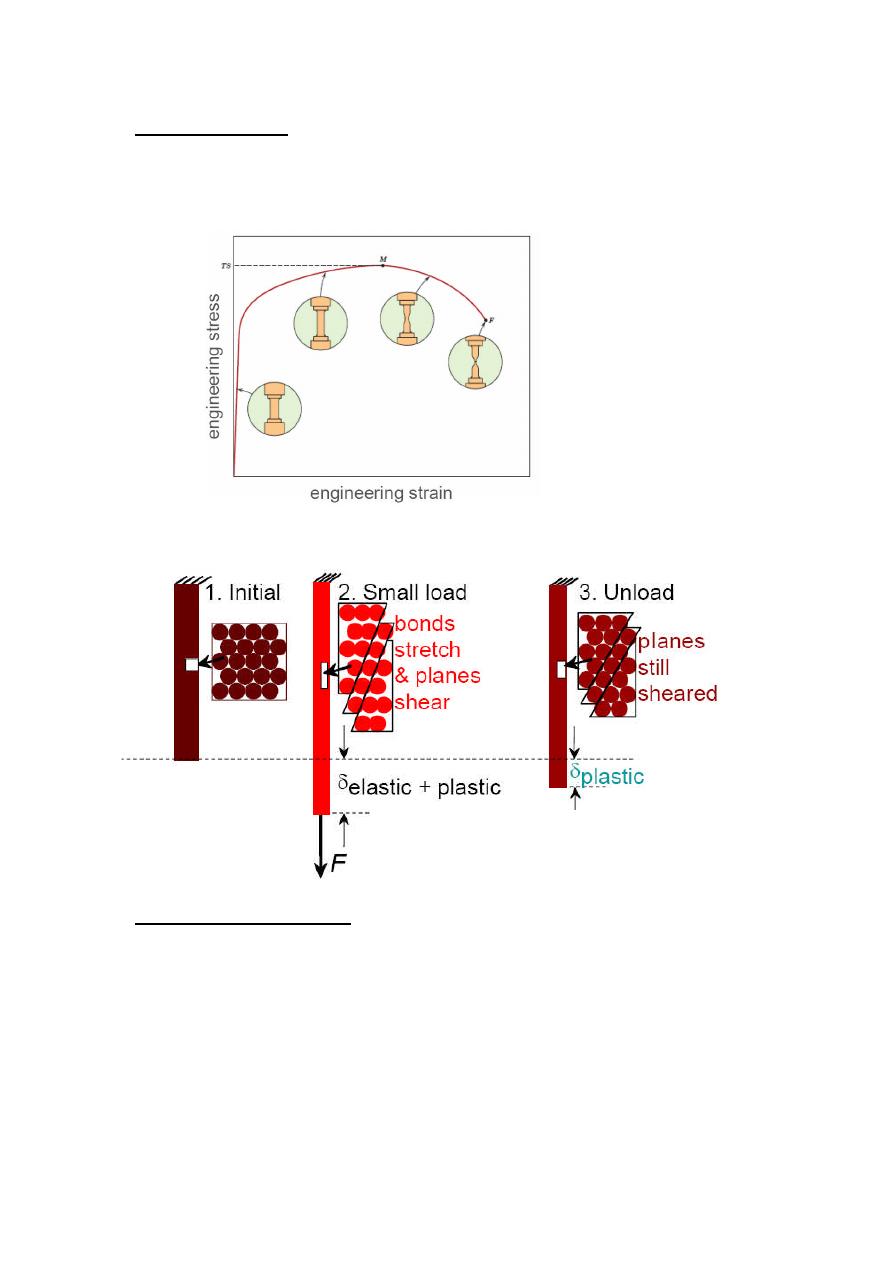
Shear Sress – Shear Strain
Shear stress
, τ
= F/A
0
F is applied parallel to upper and lower faces each having area A
0
.
Shear strain, γ = tan θ = w/l
0
(* 100 %), θ is strain angle
Lecture 5
Mechanical Properties
3
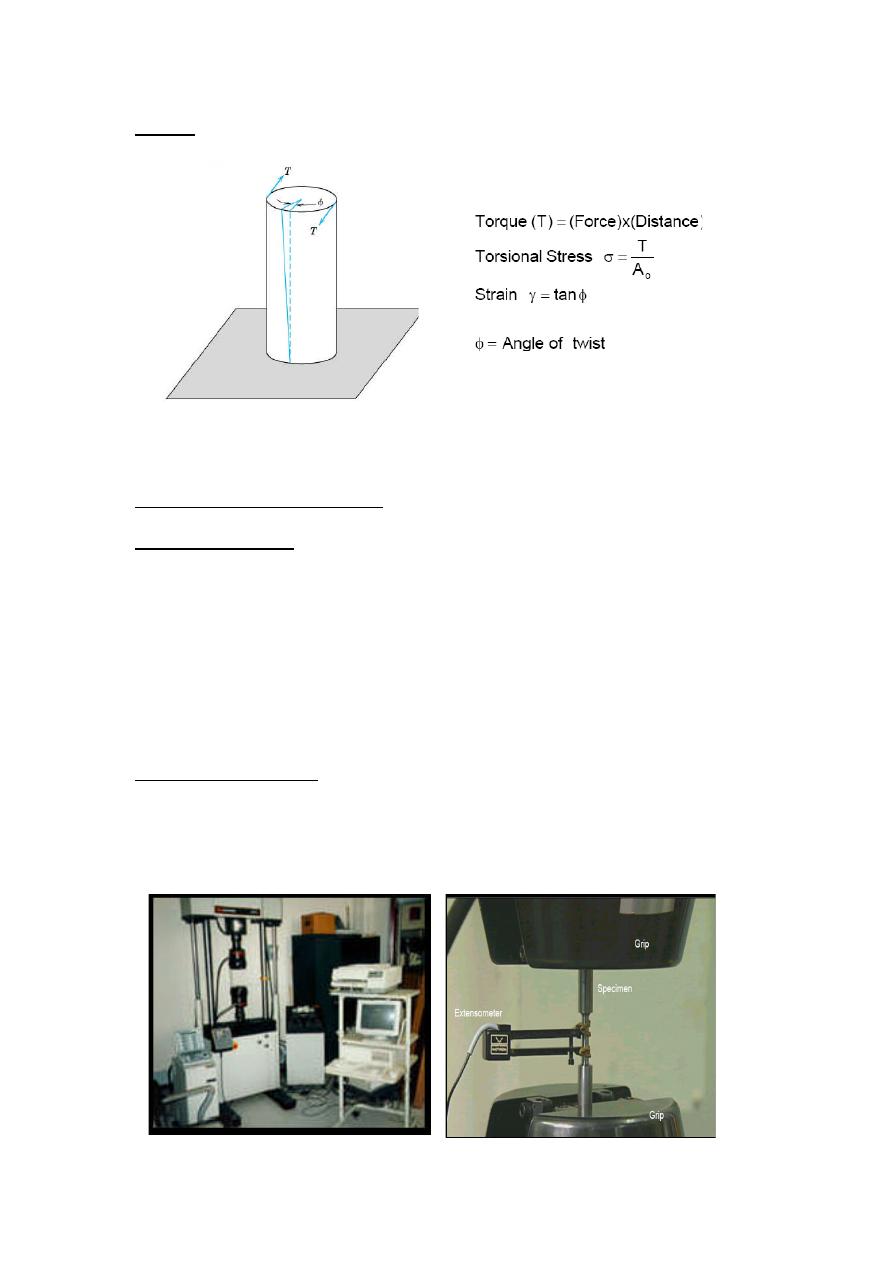
Torsion
STRESS – STRAIN DIAGRAM
Tension/Tensile Test
Tensile test determines the strength of the material when subjected to a simple
stretching operation. Strength and stress are not the same thing. Stress is a
function of the applied load while strength is a material property.
Uniform stressed state is formed over the cross section of a smooth specimen
of either circular or rectangular cross section.
Typically, test samples of standard dimension are pulled slowly at a constant
rate (strain rates between 10
-5
and 10
0
per second) in a testing machine
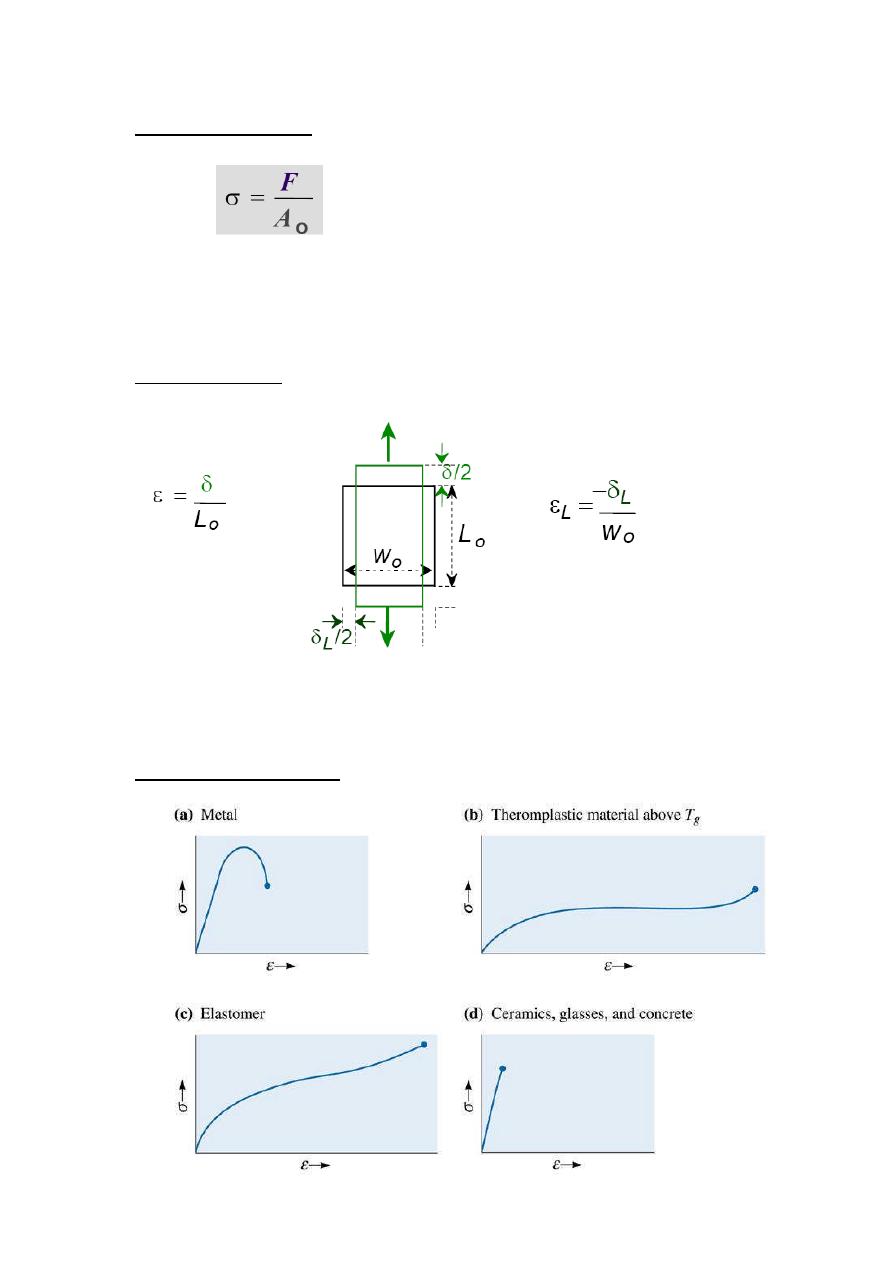
Tensile Test Equipment
The specimen to be tested is clamped by two grips. The grips are driven by a powerful
hydraulic actuator. Once the specimen has been attached to the grips, the vertical
movements of the grips generate the desired loading on the specimen.
Lecture 5
Mechanical Properties
4
Engineering Stress (σ);
F – Load applied perpendicular to the specimen cross section (N)
Ao – original cross section area (m
2
)
The unit of σ = MPa (where 1MPa= 10
6
N/ m
2
)
Engineering Strain
Tensile strain:
Lateral strain:
Where;
δ = change in length
Lo = original length before load is applied
Strain is always dimensionless
Stress-Strain Behavior
Lecture 5
Mechanical Properties
5
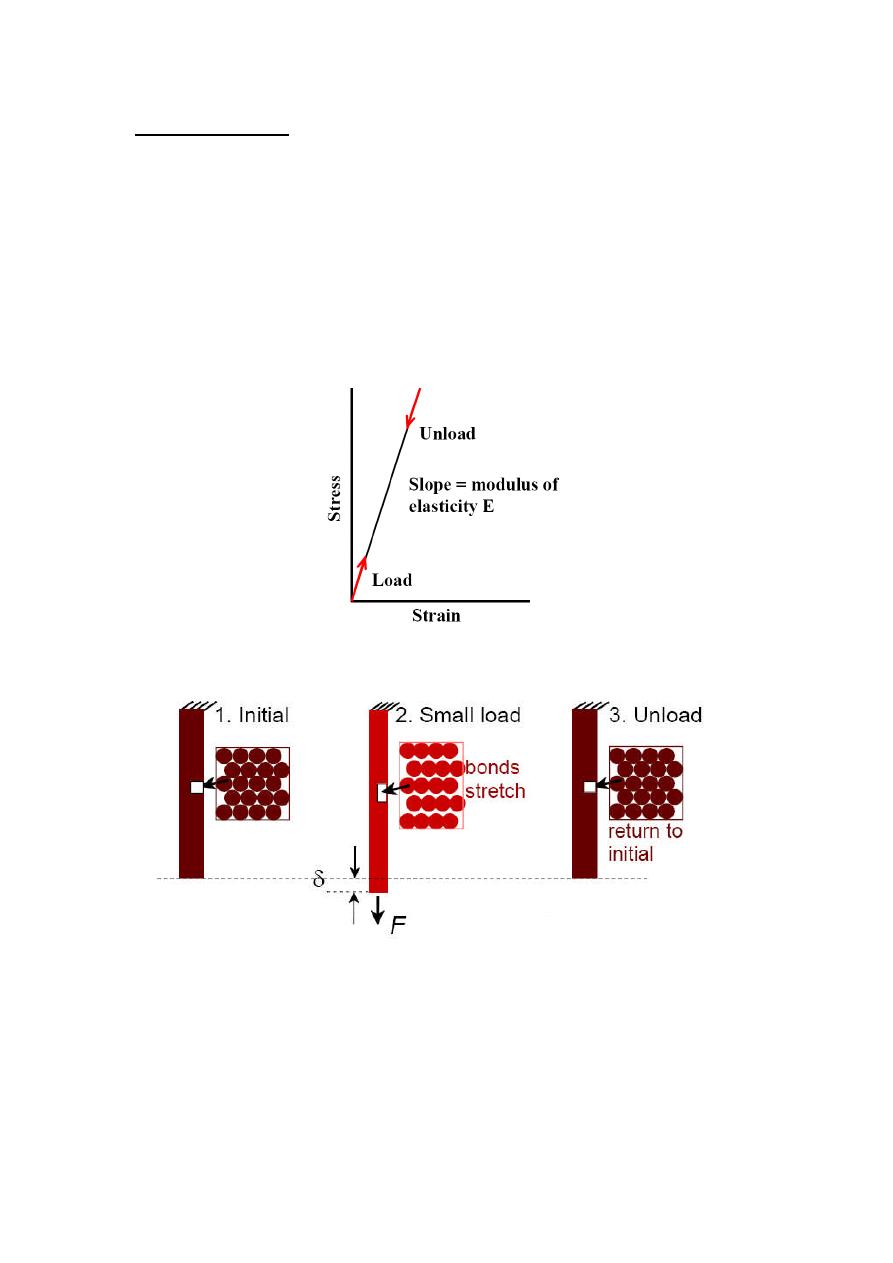
Elastic Deformation
Reversible: when the stress is removed, the material returns to the dimensions
it had before the loading.
Usually strains are small (except for the case of some plastics, e.g. rubber).
In tensile tests, if the deformation is elastic, the stress strain relationship is
called Hooke's law:
σ = E ε
E is Young's modulus or modulus of elasticity, has the same units as σ, N/m
2
or Pa
Lecture 5
Mechanical Properties
6
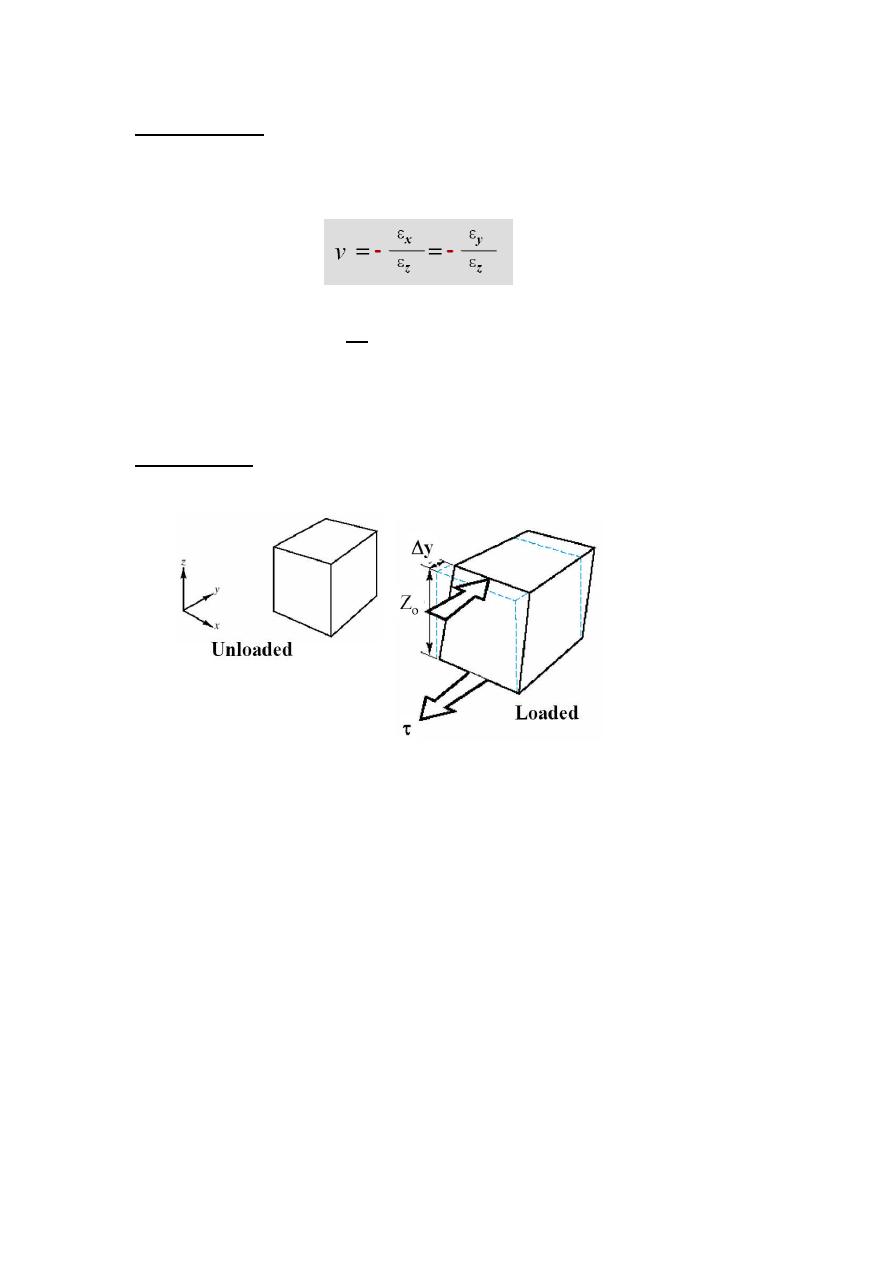
Nonlinear Elastic Behavior
In some materials (many polymers, concrete...), elastic deformation is not linear, but it
is still reversible.
Lecture 5
Mechanical Properties
7
Poisson's ratio, ν
Poisson’s ratio (v) is defined as the ratio of lateral and axial strain
The maximum value of v is 0.5
For many metal and alloys, values of v range between 0.2 to 0.35
Units:
E: [GPa], ν: dimensionless
Shear Modulus
Relationship of shear stress to shear strain:
τ = G γ
G is Shear Modulus (Units: N/m
2
or Pa)
Lecture 5
Mechanical Properties
8
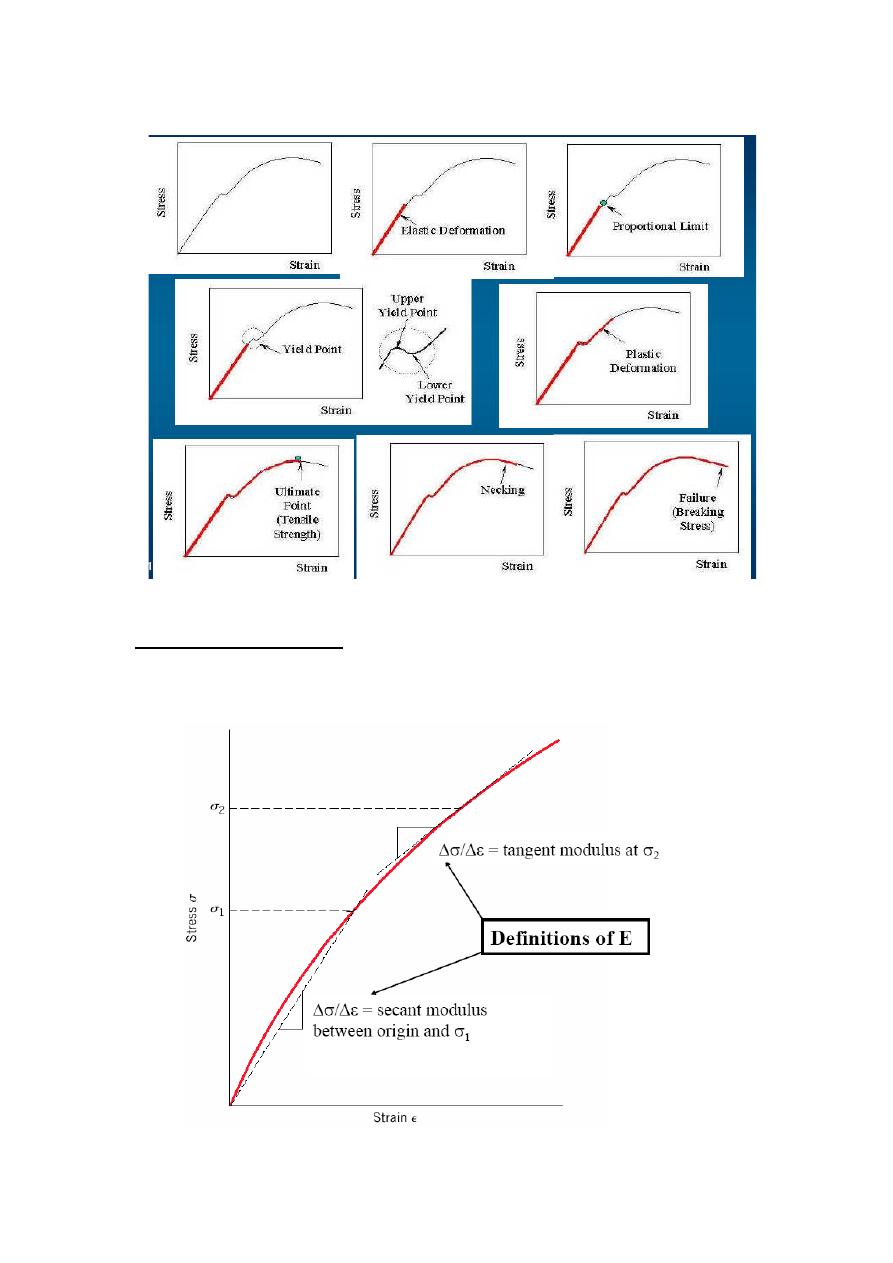
Plastic Deformation
stress and strain are not proportional to each other
the deformation is not reversible
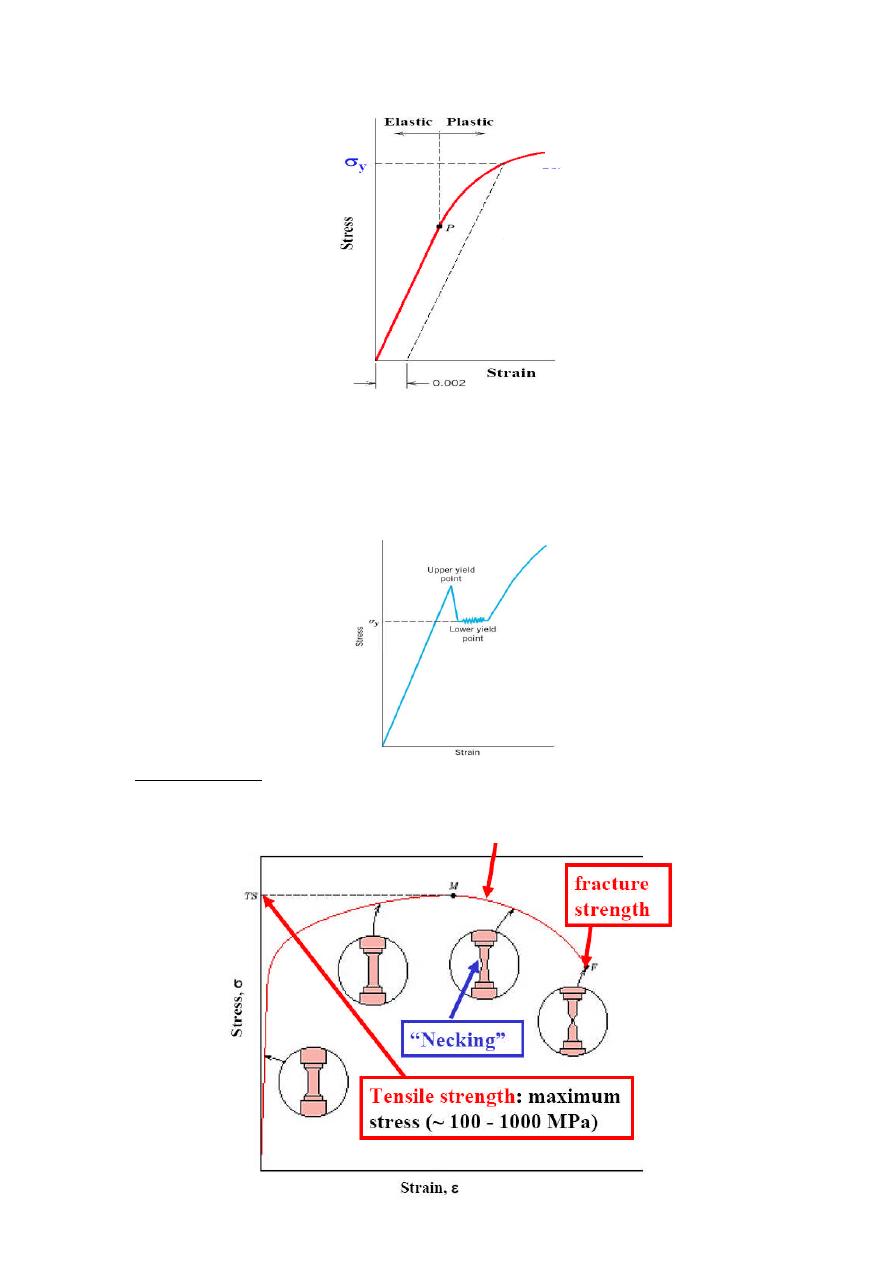
Tensile Properties: Yielding
Yield strength σy - is chosen as that causing a permanent strain of 0.002
Yield point P - the strain deviates from being proportional to the stress (the
proportional limit)
The yield stress is a measure of resistance to plastic deformation
Lecture 5
Mechanical Properties
9
Some steel and other materials exhibit stress strain behavior which
demonstrating the yield point phenomenon
Thus it not necessary to employ the strain offset method to determine the
yield strength
Yield strength = average stress that is associated with the lower yield point
Tensile Strength
If stress = tensile strength is maintained then specimen will eventually break
Lecture 5
Mechanical Properties
10
For structural applications, the yield stress is usually a more important property than
the tensile strength, since once the yield stress has passed, the structure has deformed
beyond acceptable limits.
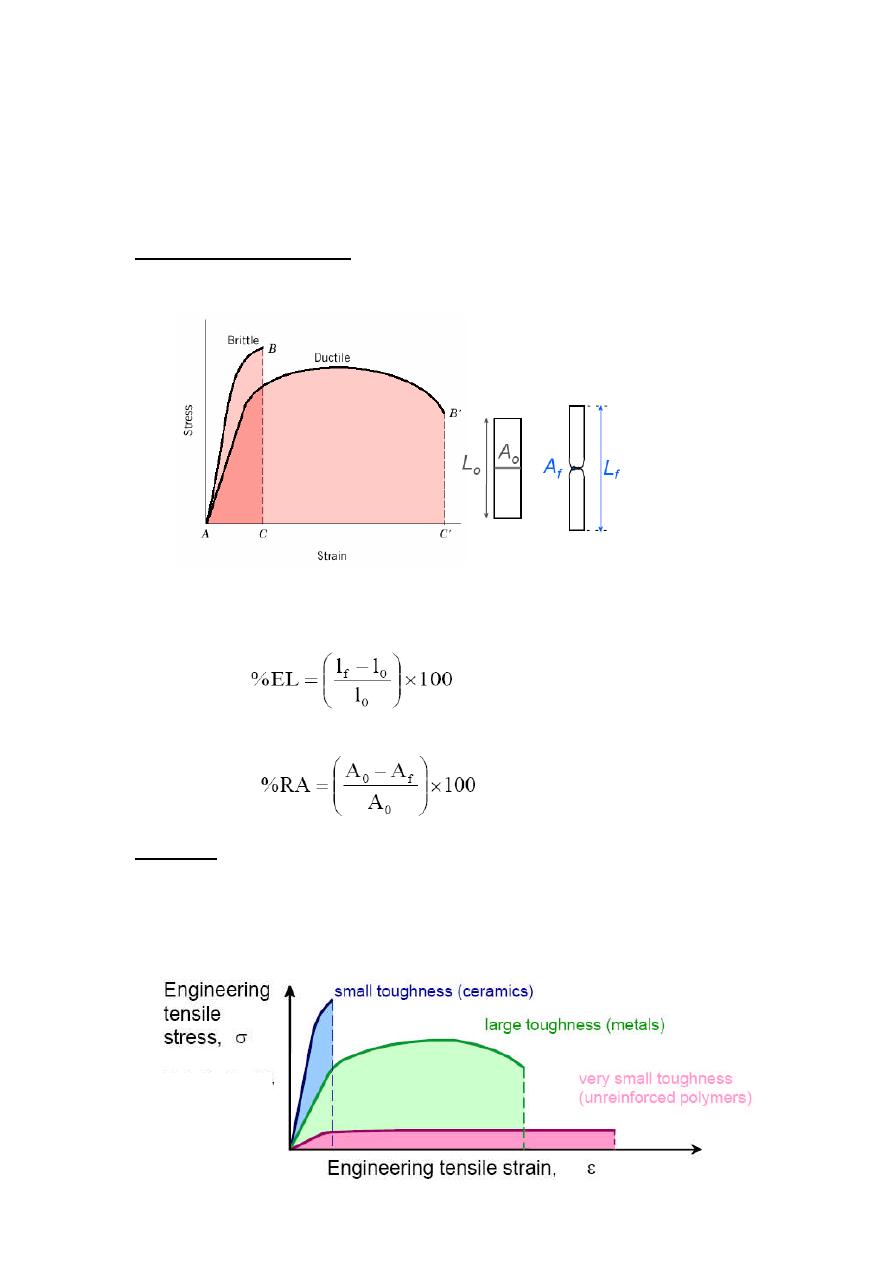
Tensile properties: Ductility
Ductility is a measure of the deformation at fracture
Defined by percent elongation (plastic tensile strain at failure)
or percent reduction in area
Toughness
• Energy to break a unit volume of material
• Approximate by the area under the stress-strain curve.
Lecture 5
Mechanical Properties
11
Brittle fracture: elastic energy
Ductile fracture: elastic + plastic energy
Units: the energy per unit volume, e.g. J/m
3
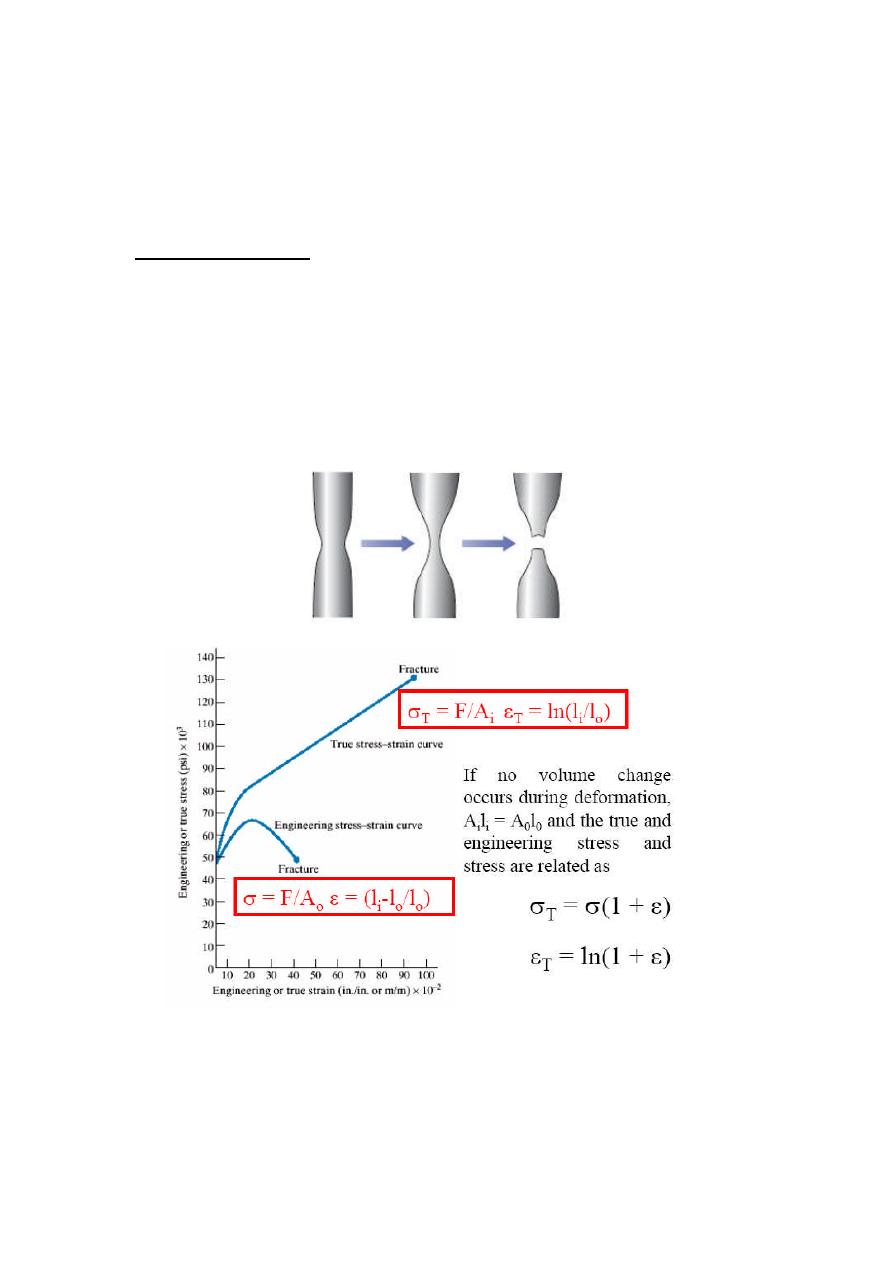
True Stress and Strain
True stress = load divided by actual area in the necked-down region (A
i
):
σ
T
= F/A
i
Sometimes it is convenient to use true strain defined as
ε
T
= ln(l
i
/l
o
)
True stress continues to rise to the point of fracture, in contrast to the engineering
stress.