
1
Fragile X syndrome
Information:
The prevalence of significant learning difficulties in males due to fragile X syndrome is
about 1 in 4000.
This condition was initially diagnosed on the basis of the appearance of an apparent
gap or break (a fragile site) in the distal part of the long arm of the X chromosome.
Diagnosis is now achieved by molecular analysis of the CGG trinucleotide repeat
expansion in the relevant gene (FMR1).
Although it is inherited as an X-linked recessive disorder, a substantial proportion of
obligate female carriers have learning difficulties (usually mild to moderate) and
around one-fifth of males who inherit the mutation are phenotypically normal but may
pass the disorder on to their grandsons through their daughters.
These unusual findings are explained by the nature of the mutation, which occurs in
‘pre-mutation’ and ‘full mutation’ forms.
The normal copy of the gene contains fewer than 50 copies of the CGG trinucleotide
repeat sequence and is stable when transmitted to offspring.
Genes with the pre-mutation contain 55–199 copies of the repeat sequence.
This expansion causes no intellectual disability in male or female carriers, but is
unstable and may become larger during transmission through females.
Genes with the full mutation contain more than 200 copies of the repeat sequence.
This affects gene function, causing the clinical features of fragile X syndrome in
virtually all males and around half of female carriers.
These full mutations always arise from expansion of pre-mutations, and never arise
directly from normal genes.
Hence all mothers of affected males are carriers.
Clinical findings in males in fragile X Syndrome:
Moderate–severe learning difficulty (IQ 20–80, mean 50).
Macrocephaly.
Macro-orchidism – postpubertal.
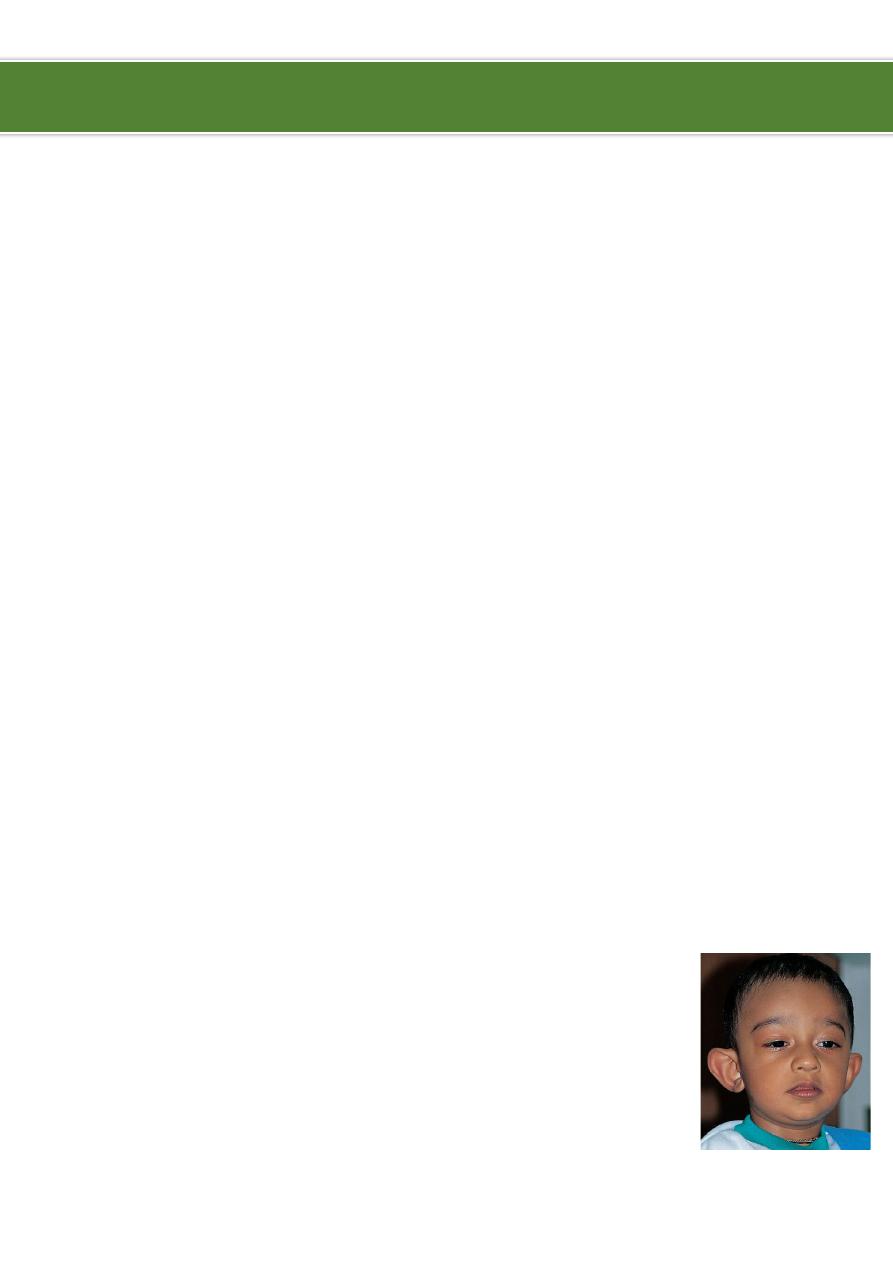
Characteristic facies (long face, large everted ears, prominent
mandible and broad forehead, most evident in affected adults).
Other features (mitral valve prolapse, joint laxity, scoliosis, autism, hyperactivity).
Ibnlatef
Notes
Pediatrics

2
Signs and symptoms:
Developmental features:
o
During infancy, developmental milestones may be delayed, especially gross motor
development secondary to hypotonia.
o
After the first year of life, delays in speech and language are notable, and fine
motor skills are impaired.
o
As the patient matures, perseveration and echolalia may dominate speech patterns.
o
Expressive language ability, short-term memory, and attempts at problem solving
are significantly impaired.
Cognitive features:
o
IQ frequently indicates mild-to-severe mental retardation (20-70).
o
Females and less-affected males may have IQs that approach 80.
o
IQ may be higher in childhood than in adulthood because of slowing mental
development and difficulties with IQ test taking rather than loss of intellect.
o
IQ in patients with premutations can be normal or slightly decreased.
Neuropsychological features:
o
Depression.
o
General and separation anxiety.
o
Oppositional defiant disorder.
o
Autisticlike behavior.
o
In almost all male patients, behavioral features similar to those of attention deficit-
hyperactivity disorder (ADHD), including aggressive tendencies and attention
deficits.
o
Seizure disorders (typically complex partial seizures with onset at age 6-24 months).
o
As children, difficulty when routines are altered.
o
Features of obsessive-compulsive disorder, sensory integration disorder, or both.
o
Self-injurious behavior and significant tantrums.
Musculoskeletal features:
o
Pes planus.
o
Pectus excavatum.
o
Joint laxity.
o
Scoliosis.
o
Joint dislocation.
Feeding difficulties:
o
Reflux, vomiting, or both.
o
Rarely, failure to gain weight during infancy and childhood.
o
In a minority of patients, a Prader-Willi phenotype, which includes obesitydue to
severe hyperphagia.
Sleep disturbance:
o
Difficulty falling asleep.

3
o
Frequent awakening.
o
Loud snoring, with or without obstructive sleep apnea.
o
Recurrent nonspecific medical problems.
Recurrent sinusitis:
o
Otitis media.
o
Decreased visual acuity.
Diagnosis:
DNA testing for fragile X syndrome is recommended.
Karyotyping may reveal other chromosomal anomalies, and both a standard karyotype
and DNA testing are suggested.
The criterion standard diagnostic test involves molecular genetic techniques that
detect the FMR1 gene.
The exact number of CGG triplet repeats can be determined.
Southern blot and polymerase chain reaction (PCR) are the 2 methods of genetic
analysis that are currently available.
Management:
Routine care involves treating the medical problems that these patients commonly
experience, including gastroesophageal reflux, sinusitis, and otitis media.
During infant and early childhood healthcare maintenance visits, focus examination on
possible hip dislocations, hernias, and hypotonia.
Genetic specialist Genetic counseling.
Speech and language therapist.
Occupational and physical therapist.
Behavioral intervention/modification team.
Special education professional.
Psychology or behavioral specialist.
Neurologist Consult a neurologist if seizures persist.
Cardiologist.
Otolaryngologist Patients with chronic sinusitis and chronic otitis media.
Ophthalmologist Important for patients with strabismus.
Gastroenterologist.
Orthopedic surgeon Assesses patients for abnormal gait caused by pes planus,
which is managed with orthotic inserts or orthopedic shoes, and may provide surgical
intervention for severe scoliosis.
Nutritionist For patients with the Prader-Willi syndrome phenotype.
----------------------------------------------------------------------------------------------
www.facebook.com/ibnlatef
https://goo.gl/RpvNsl