

1 |
P a g e
Pyrexia of unknown orgin (PUO)
Dr.
Salam Fareed
Contents
• Objectives
• Definition
• Classification and causes
• Approach to patient with PUO
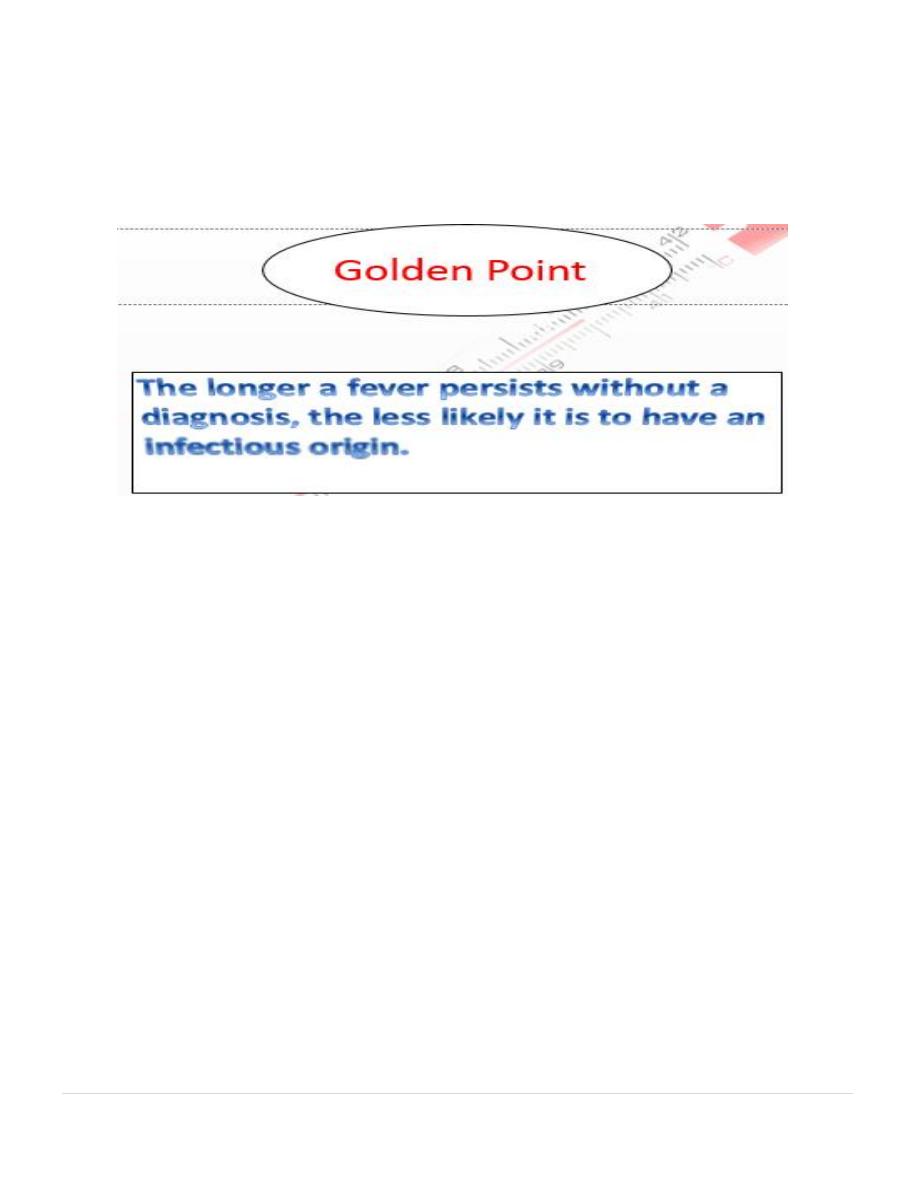
• Golden point
• Case scenario
Objectives
• To be able to define PUO, and its tyups.
• To be able to have a plan to approach a patient with Fever when the basic clinical and
laboratory tests did not reveal much as to the cause of fever
Fever of unknown origin (FUO) :-
_
is a sustained, unexplained fever despite a comprehensive diagnostic evaluation.
Patients with undiagnosed FUO generally have a benign long-term course, especially
when the fever is not accompanied by substantial weight loss or other signs of a
serious underlying disease.
Classification of PUO
•
Classic:
_
Temperature >38.3 °C (100.9 °F)
_
for at least 3 weeks
_
with at least 1 week
of in-hospital investigation
Causes

2 |
P a g e
1- Infections (30%):-
_
Abscess at any site; Cholecystitis/cholangitis
_
Urinary tract infection: prostatitis
_
Dental and sinus infections
_
Bone and joint infections
_
Imported infections, e.g. malaria, dengue, brucellosis
_
Enteric fevers
_
Infective endocarditis
_
Tuberculosis (particularly extra pulmonary)
_
Viral infections (cytomegalovirus-CMV, Epstein-Barr virus-EBV, human
immunodeficiency virus-HIV) and toxoplasmosis
2-Malignancy (20%):-
_
Lymphoma and myeloma
_
Leukemia
_
Solid tumors (renal, liver, colon, stomach, pancreas)
3-connective tissue disorders(15%):-
_
Vasculitic disorders (including polyarteritis nodosa and rheumatoid disease with
vasculitis)
_
Temporal arteritis/polymyalgia rheumatica
_
Systemic lupus erythematosus (SLE)
_
Still's disease
_
Polymyositis
4-Miscellaneous (20%):-
_
Inflammatory bowel disease
_
Liver disease: cirrhosis and granulomatous hepatitis
_
Sarcoidosis
_
Drug reactions
_
Atrial myxoma
_
Thyrotoxicosis
_
Hypothalamic lesions
_
Familial Mediterranean fever
5-Factitious
6-No diagnosis (15%)

3 |
P a g e
Health care associated
_
Temperature >38.3 °C (100.9 °F) in patients hospitalized ≥72 hours but no fever or
evidence of potential infection at the time of admission, and negative evaluation of at
least 3 days.
Causes
_
Drug fever
_
thrombophlebitis
_
pulmonary embolism
_
sinusitis, postoperative complications (occult abscesses)
_
Clostridium difficile enterocolitis
_
device- or procedure-related endocarditis
Neutropenic (immune deficient)
_
Temperature >38.3 °C (100.9 °F) and neutrophil count <500/µL for >3 days and
negative evaluation after 48 hours.
Causes
_
Occult bacterial and opportunistic fungal infections (aspergillosis, candidiasis)
_
drug fever
_
pulmonary emboli
_
underlying malignancy
_
cause not documented in 40%-60% of cases
HIV associated
_
Temperature >38.3 °C (100.9 °F) for >3 weeks (outpatients) or >3 days (inpatients) in
patients with confirmed HIV infection.
Approach to patient with PUO
History-Physical examination Targeted investigations
History
_
Inquire about symptoms involving all major organ systems and get a detailed history
of general symptoms (eg, fever, weight loss, night sweats, headaches, rashes).
_
The history can provide important clues to FUO due to surgery, zoonoses, malignancies,
and inflammatory/immune disorders.

4 |
P a g e
_
Record all symptoms, even those that disappeared before the examination. Previous
illnesses (including psychiatric illnesses) and surgeries are important.
Make a detailed evaluation that includes the following:
_
Family history
_
Immunization status
_
Occupational history
_
Travel history
_
Nutrition (including consumption of dairy products)
_
Drug history (over-the-counter medications, prescription medications, illicit
substances)
_
Sexual history
_
Recreational habits
_
Animal contacts (including possible exposure to ticks and other vectors)
Physical Examination
_
Definitive documentation of fever and exclusion of factitious fever are essential
early steps in the physical examination.
_
On physical examination, pay special attention to the eyes, skin, lymph nodes, spleen,
heart, abdomen, and genitalia.
_
Pulse-temperature relationships (ie, relative bradycardia) are useful in evaluating for
typhoid fever, Q fever, psittacosis, lymphomas, and drug fevers.
_
Repeat a regular physical examination daily while the patient is hospitalized.
Pay special attention to rashes, new or changing cardiac murmurs, signs of arthritis,
abdominal tenderness or rigidity, lymph node enlargement, funduscopic changes,
and neurologic deficits.
Investigations
_
PUO should be investigated in a stepwise fashion in order of increasing complexity
and invasiveness, starting with blood tests and moving to imaging techniques and,
finally, more invasive procedures such as 'blind' biopsies
_
FBC with differential , (ESR) and C-reactive protein (CRP)
_
Urea, creatinine and electrolytes
_
Liver function tests (LFTs) and γ-glutamyl transferase
_
Blood glucose
_
Urinalysis, Midstream urine (MSU) for microscopy and culture

5 |
P a g e
_
Creatine phosphokinase
_
Malaria blood films
_
Faeces culture
_
Sputum for routine microscopy and culture and microscopy and culture for
mycobacteria
_
Blood cultures ×3
_
Chest X-ray
_
Ultrasound examination of abdomen
_
Electrocardiogram (ECG)
_
Echocardiogram
_
Viral (CMV, Infectious mononucleosis, HIV, Hepatitis A, B and C)
_
Bacterial (chlamydial infection, Q fever, brucellosis , mycoplasma infection, syphilis,
leptospirosis, Lyme disease, Yersinia infection, streptococcal infection)
_
Fungal(Cryptococcus antigen, histoplasmosis, coccidioidomycosis)
_
Protozoal and parasitic (toxoplasmosis, amoebiasis, schistosomiasis, leishmaniasis,
trypanosomiasis)
_
PCR e.g for tuberculosis, herpes simplex virus (HSV), CMV, HIV, erythrovirus,
dengue, Toxoplasma, Whipple's disease
_
Immunology like Autoantibody screen, including anti-double-stranded DNA, anti-
neutrophil cytoplasmic antibody (ANCA), Immunoglobulins, Complement (C3 and
C4) levels &Cryoglobulins
_
Imaging like CT/MRI chest and abdomen, skeletal survey , isotope bone scan, labelled
white cell scan
_
Biopsy: Bone marrow biopsy, Temporal artery biopsy
Factitious fever
_
It is most commonly encountered among young adults with health care experience
or knowledge.
_
Evidence of psychiatric problems or a history of multiple hospitalizations at
different institutions is common in patients with factitious fever.
6 |
P a g e
_
Rapid changes of body temperature without associated shivering or sweating, large
differences between rectal and oral temperature, and discrepancies between fever,
pulse rate, or general appearance are typically observed in patients who manipulate
or exchange their thermometers.
1. The most probable cause of immune deficient PUO is :-
Streptococcal pneumonia
Thrombophlebitis
Drug fever
Unknown
2. A 45 years old male known to have chronic renal failure, admitted to the hospital to
start hemodialysis at that time he was afebrile, 3 days later he developed fever of
(39°C) persist for 3 days.
CBC showed Hb=9 g/dl, WBC=13*10
9
cells/l, platelets count=170*10
9
this type of
fever is most probably:-
_
Immune deficient PUO
_
Health care associated PUO
_
Classic PUO
_
None of above
3) All the followings are criteria for immune deficient (neutropenic) PUO except :-
_
Temperature >38.3°C
_
Duration > 3 weeks
_
Neutrophile count 400
_
No valuabie diagnosis despite initial 48 hours of assessment

7 |
P a g e
4-A patient can be considered to have classic PUO in which of the followings scenario :-
_
69 years old female with fever ranging (38.4°C - 38.8°C) for 40 days without finding a
source of infection despite 10 days of inpatient investigations.
_
33 years old diabetic female present with fever of (39.5°C) for 3 days associated with
rigor and loin pain.
_
18 years old female presented with fever ranging (38.5°C -39.7°C) for 1 month
duration, with previous history of multiple hospital admissions and history of
psychiatric problem.
_
23 years old female presented with fever of (38.9°C) and backache for 14 days
duration, initial assessment showed high titer of Brucella agglutination test.