

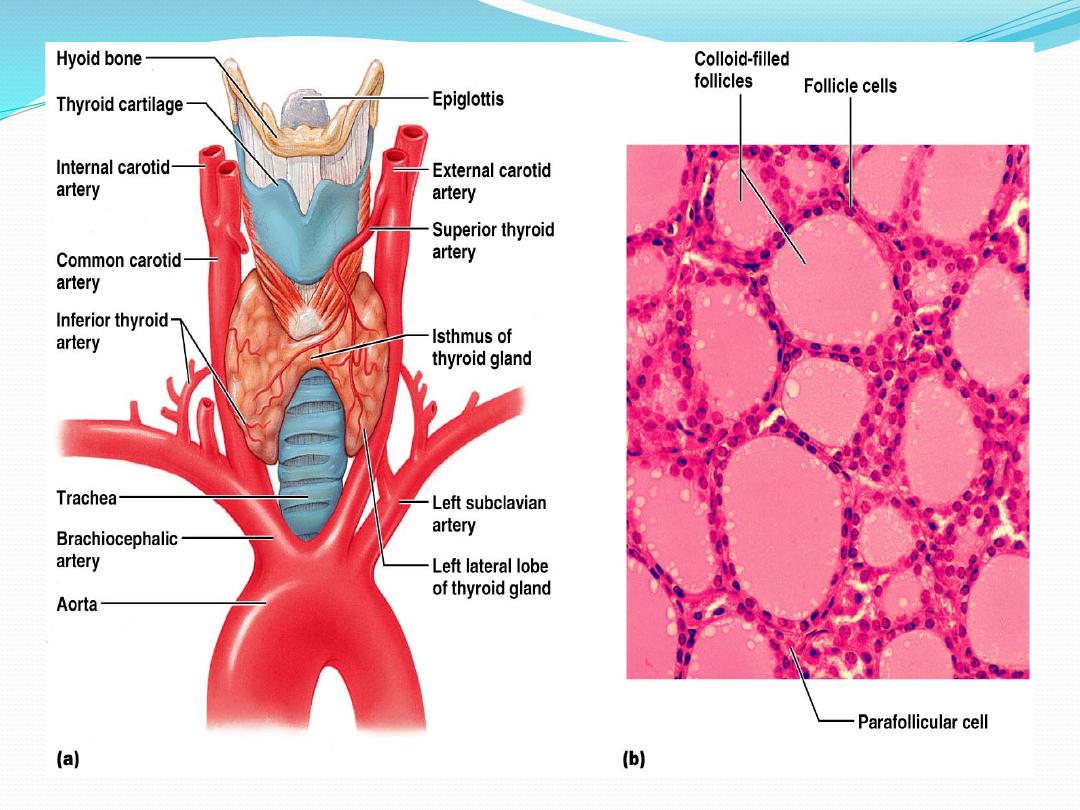
The largest endocrine gland, located in the
anterior neck, consists of two lateral lobes
connected by a median tissue mass called the
isthmus
Composed of follicles that produce the
glycoprotein thyroglobulin
Colloid (thyroglobulin + iodine) fills the lumen of
the follicles and is the precursor of thyroid
hormone
Other endocrine cells, the parafollicular cells,
produce the hormone calcitonin

Thyroid Hormone
Thyroid hormone – major metabolic hormone
Consists of two related iodine-‐containing
compounds
T
4
– thyroxine; has two tyrosine molecules plus
four bound iodine atoms
T
3
– triiodothyronine; has two tyrosines with
three bound iodine atoms

Effects of Thyroid Hormone
TH is concerned with:
Glucose oxidation
Increasing metabolic rate
Heat production
TH plays a role in:
Maintaining blood pressure
Regulating tissue growth
Developing skeletal and nervous systems
Maturation and reproductive capabilities

Synthesis of Thyroid Hormone
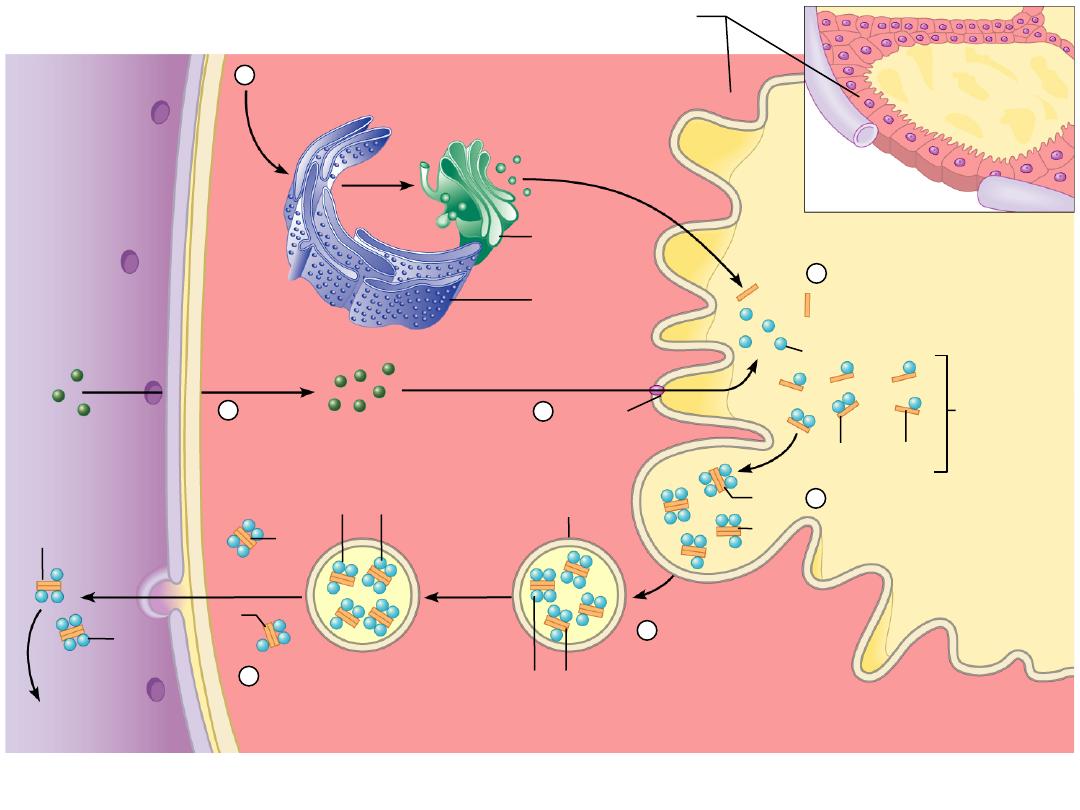
Thyroglobulin is synthesized and discharged into
the lumen
Iodides (I
–
) are actively taken into the cell,
oxidized to iodine (I
2
), and released into the
lumen
Iodine attaches to tyrosine, forming T
1
(monoiodotyrosine, or MIT), and T
2
(diiodotyrosine, or DIT)

Synthesis of Thyroid Hormone
Iodinated tyrosines link together to form T
3
and
T
4
Colloid is then endocytosed and combined with a
lysosome, where T
3
and T
4
are cleaved and diffuse
into the bloodstream
8
Iodine
T
4
T
4
T
4
T
3
T
3
T
3
T
3
T
4
Lysosome
Capillary
Iodide
(I
–
)
Thyroid
follicle cell
Colloid in lumen of follicle
To peripheral
tissues
T
4
T
3
Lysosomal enzymes cleave
T
4
and T
3
from thyroglobulin
colloid and hormones diffuse
from follicle cell into bloodstream
Thyroglobulin colloid
is endocytosed and
combined with a
lysosome
Iodinated tyrosines are
linked together to form
T
3
and T
4
Thyroglobulin
colloid
Iodine is attached
to tyrosine in colloid,
forming DIT and MIT
Thyroglobulin is synthesized
and discharged into the follicle lumen
Iodide (I
–
)
is trapped
(actively transported in)
DIT (T
2
) MIT (T
1
)
Colloid
Golgi
apparatus
Rough ER
Iodide is
oxidized
to iodine
1
2
3a
5
6
3b
4

Transport and Regula:on of TH
T
4
and T
3
bind to thyroxine-‐binding globulins (TBGs)
produced by the liver
Both bind to target receptors, but T
3
is ten times more
active than T
4
Peripheral tissues convert T
4
to T
3
Mechanisms of activity are similar to steroids
Regulation is by negative feedback
Hypothalamic thyrotropin-‐releasing hormone (TRH)
can overcome the negative feedback

Calcitonin
A peptide hormone produced by the
parafollicular, or C cells
Lowers blood calcium levels in children
Antagonist to parathyroid hormone (PTH)
Regulated by a humoral (calcium ion
concentration in the blood) negative feedback
mechanism

Calcitonin
Calcitonin targets the skeleton, where it:
Inhibits osteoclast activity (and thus bone
resorption) and release of calcium from the
bone matrix
Increases calcium excretion by the kidneys
Stimulates calcium uptake and incorporation
into the bone matrix

Parathyroid Glands
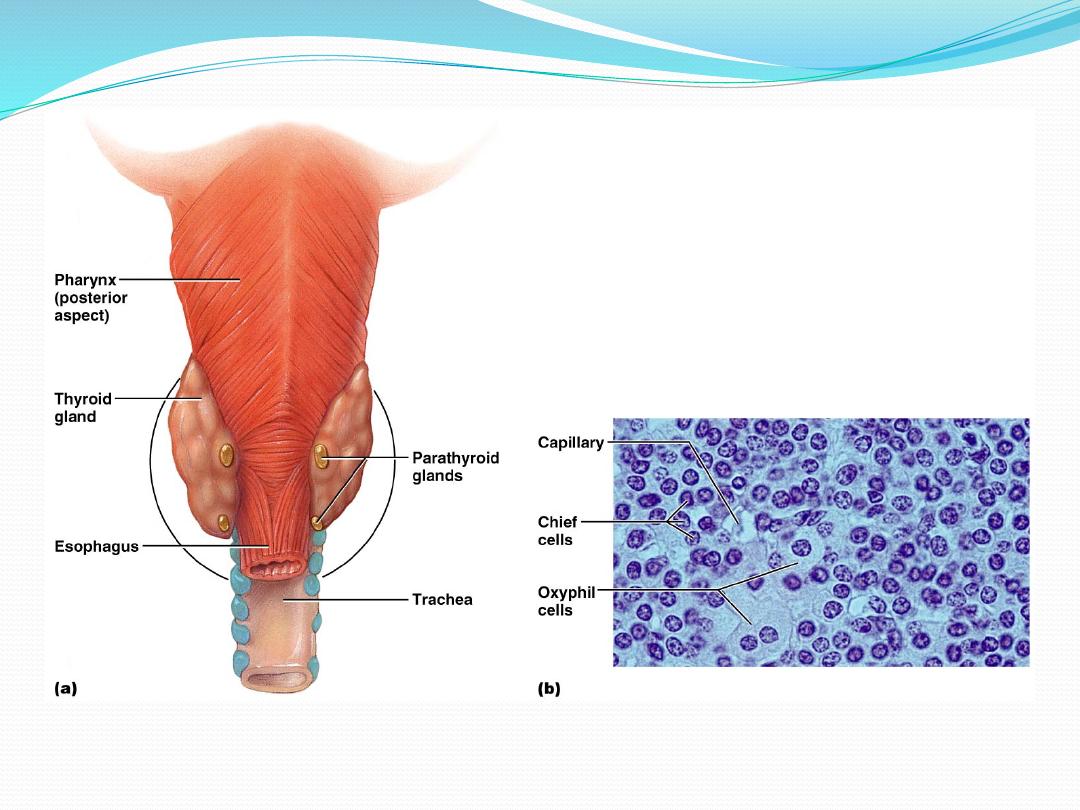
Tiny glands embedded in the posterior aspect of the
thyroid
Cells are arranged in cords containing oxyphil and
chief cells
Chief (principal) cells secrete PTH
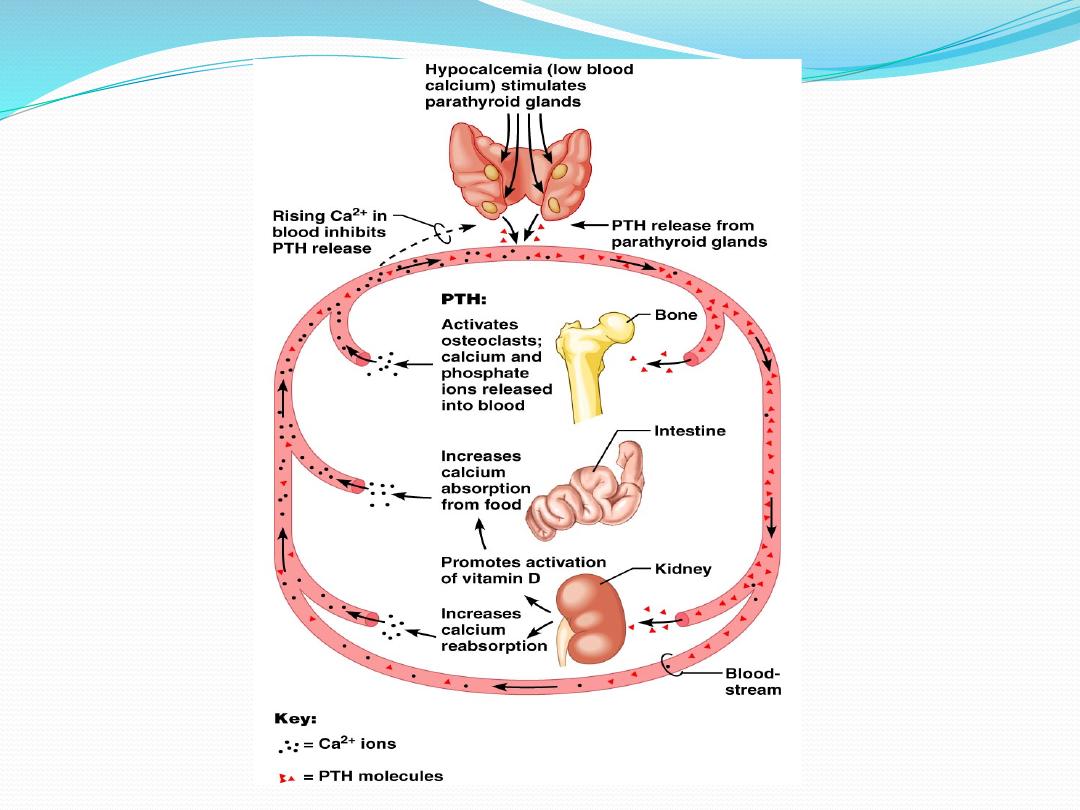
PTH (parathormone) regulates calcium balance in the
blood
Parathyroid Glands

Effects of Parathyroid Hormone
PTH release increases Ca
2+
in the blood as it:
Stimulates osteoclasts to digest bone matrix
Enhances the reabsorption of Ca
2+
and the
secretion of phosphate by the kidneys
Increases absorption of Ca
2+
by intestinal
mucosal
Rising Ca
2+
in the blood inhibits PTH release

Thanks